 Add to Chrome
 Add to Firefox
 Add to Edge
ZEST: Zero-shot Embodied Skill Transfer for Athletic Robot Control
Jan 30, 2026
Achieving robust, human-like whole-body control on humanoid robots for agile, contact-rich behaviors remains a central challenge, demanding heavy per-skill engineering and a brittle process of tuning controllers. We introduce ZEST (Zero-shot Embodied Skill Transfer), a streamlined motion-imitation framework that trains policies via reinforcement learning from diverse sources -- high-fidelity motion capture, noisy monocular video, and non-physics-constrained animation -- and deploys them to hardware zero-shot. ZEST generalizes across behaviors and platforms while avoiding contact labels, reference or observation windows, state estimators, and extensive reward shaping. Its training pipeline combines adaptive sampling, which focuses training on difficult motion segments, and an automatic curriculum using a model-based assistive wrench, together enabling dynamic, long-horizon maneuvers. We further provide a procedure for selecting joint-level gains from approximate analytical armature values for closed-chain actuators, along with a refined model of actuators. Trained entirely in simulation with moderate domain randomization, ZEST demonstrates remarkable generality. On Boston Dynamics' Atlas humanoid, ZEST learns dynamic, multi-contact skills (e.g., army crawl, breakdancing) from motion capture. It transfers expressive dance and scene-interaction skills, such as box-climbing, directly from videos to Atlas and the Unitree G1. Furthermore, it extends across morphologies to the Spot quadruped, enabling acrobatics, such as a continuous backflip, through animation. Together, these results demonstrate robust zero-shot deployment across heterogeneous data sources and embodiments, establishing ZEST as a scalable interface between biological movements and their robotic counterparts.

Curriculum-Based Strategies for Efficient Cross-Domain Action Recognition
Jan 20, 2026Despite significant progress in human action recognition, generalizing to diverse viewpoints remains a challenge. Most existing datasets are captured from ground-level perspectives, and models trained on them often struggle to transfer to drastically different domains such as aerial views. This paper examines how curriculum-based training strategies can improve generalization to unseen real aerial-view data without using any real aerial data during training. We explore curriculum learning for cross-view action recognition using two out-of-domain sources: synthetic aerial-view data and real ground-view data. Our results on the evaluation on order of training (fine-tuning on synthetic aerial data vs. real ground data) shows that fine-tuning on real ground data but differ in how they transition from synthetic to real. The first uses a two-stage curriculum with direct fine-tuning, while the second applies a progressive curriculum that expands the dataset in multiple stages before fine-tuning. We evaluate both methods on the REMAG dataset using SlowFast (CNN-based) and MViTv2 (Transformer-based) architectures. Results show that combining the two out-of-domain datasets clearly outperforms training on a single domain, whether real ground-view or synthetic aerial-view. Both curriculum strategies match the top-1 accuracy of simple dataset combination while offering efficiency gains. With the two-step fine-tuning method, SlowFast achieves up to a 37% reduction in iterations and MViTv2 up to a 30% reduction compared to simple combination. The multi-step progressive approach further reduces iterations, by up to 9% for SlowFast and 30% for MViTv2, relative to the two-step method. These findings demonstrate that curriculum-based training can maintain comparable performance (top-1 accuracy within 3% range) while improving training efficiency in cross-view action recognition.
CRISP: Contact-Guided Real2Sim from Monocular Video with Planar Scene Primitives
Dec 21, 2025We introduce CRISP, a method that recovers simulatable human motion and scene geometry from monocular video. Prior work on joint human-scene reconstruction relies on data-driven priors and joint optimization with no physics in the loop, or recovers noisy geometry with artifacts that cause motion tracking policies with scene interactions to fail. In contrast, our key insight is to recover convex, clean, and simulation-ready geometry by fitting planar primitives to a point cloud reconstruction of the scene, via a simple clustering pipeline over depth, normals, and flow. To reconstruct scene geometry that might be occluded during interactions, we make use of human-scene contact modeling (e.g., we use human posture to reconstruct the occluded seat of a chair). Finally, we ensure that human and scene reconstructions are physically-plausible by using them to drive a humanoid controller via reinforcement learning. Our approach reduces motion tracking failure rates from 55.2\% to 6.9\% on human-centric video benchmarks (EMDB, PROX), while delivering a 43\% faster RL simulation throughput. We further validate it on in-the-wild videos including casually-captured videos, Internet videos, and even Sora-generated videos. This demonstrates CRISP's ability to generate physically-valid human motion and interaction environments at scale, greatly advancing real-to-sim applications for robotics and AR/VR.
Diffuse-CLoC: Guided Diffusion for Physics-based Character Look-ahead Control
Mar 14, 2025We present Diffuse-CLoC, a guided diffusion framework for physics-based look-ahead control that enables intuitive, steerable, and physically realistic motion generation. While existing kinematics motion generation with diffusion models offer intuitive steering capabilities with inference-time conditioning, they often fail to produce physically viable motions. In contrast, recent diffusion-based control policies have shown promise in generating physically realizable motion sequences, but the lack of kinematics prediction limits their steerability. Diffuse-CLoC addresses these challenges through a key insight: modeling the joint distribution of states and actions within a single diffusion model makes action generation steerable by conditioning it on the predicted states. This approach allows us to leverage established conditioning techniques from kinematic motion generation while producing physically realistic motions. As a result, we achieve planning capabilities without the need for a high-level planner. Our method handles a diverse set of unseen long-horizon downstream tasks through a single pre-trained model, including static and dynamic obstacle avoidance, motion in-betweening, and task-space control. Experimental results show that our method significantly outperforms the traditional hierarchical framework of high-level motion diffusion and low-level tracking.
ASAP: Aligning Simulation and Real-World Physics for Learning Agile Humanoid Whole-Body Skills
Feb 03, 2025Humanoid robots hold the potential for unparalleled versatility in performing human-like, whole-body skills. However, achieving agile and coordinated whole-body motions remains a significant challenge due to the dynamics mismatch between simulation and the real world. Existing approaches, such as system identification (SysID) and domain randomization (DR) methods, often rely on labor-intensive parameter tuning or result in overly conservative policies that sacrifice agility. In this paper, we present ASAP (Aligning Simulation and Real-World Physics), a two-stage framework designed to tackle the dynamics mismatch and enable agile humanoid whole-body skills. In the first stage, we pre-train motion tracking policies in simulation using retargeted human motion data. In the second stage, we deploy the policies in the real world and collect real-world data to train a delta (residual) action model that compensates for the dynamics mismatch. Then, ASAP fine-tunes pre-trained policies with the delta action model integrated into the simulator to align effectively with real-world dynamics. We evaluate ASAP across three transfer scenarios: IsaacGym to IsaacSim, IsaacGym to Genesis, and IsaacGym to the real-world Unitree G1 humanoid robot. Our approach significantly improves agility and whole-body coordination across various dynamic motions, reducing tracking error compared to SysID, DR, and delta dynamics learning baselines. ASAP enables highly agile motions that were previously difficult to achieve, demonstrating the potential of delta action learning in bridging simulation and real-world dynamics. These results suggest a promising sim-to-real direction for developing more expressive and agile humanoids.
Strategy and Skill Learning for Physics-based Table Tennis Animation
Jul 23, 2024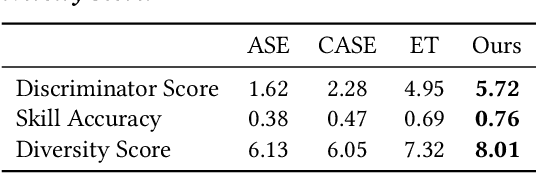
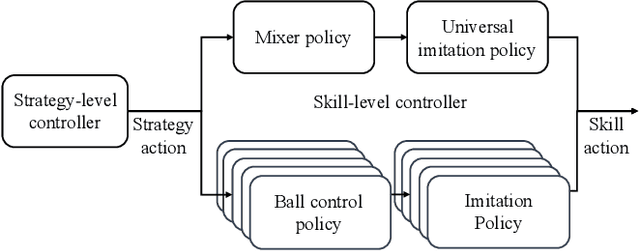
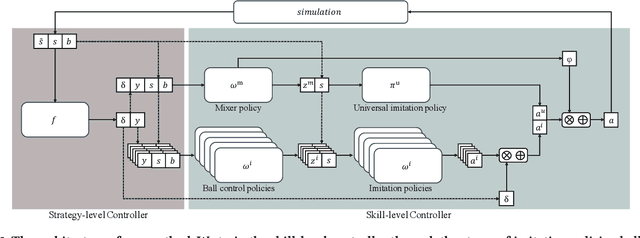
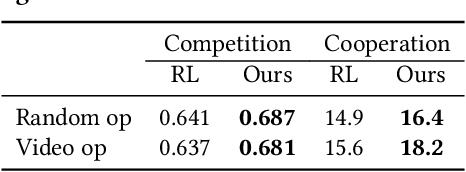
Recent advancements in physics-based character animation leverage deep learning to generate agile and natural motion, enabling characters to execute movements such as backflips, boxing, and tennis. However, reproducing the selection and use of diverse motor skills in dynamic environments to solve complex tasks, as humans do, still remains a challenge. We present a strategy and skill learning approach for physics-based table tennis animation. Our method addresses the issue of mode collapse, where the characters do not fully utilize the motor skills they need to perform to execute complex tasks. More specifically, we demonstrate a hierarchical control system for diversified skill learning and a strategy learning framework for effective decision-making. We showcase the efficacy of our method through comparative analysis with state-of-the-art methods, demonstrating its capabilities in executing various skills for table tennis. Our strategy learning framework is validated through both agent-agent interaction and human-agent interaction in Virtual Reality, handling both competitive and cooperative tasks.
SMPLOlympics: Sports Environments for Physically Simulated Humanoids
Jun 28, 2024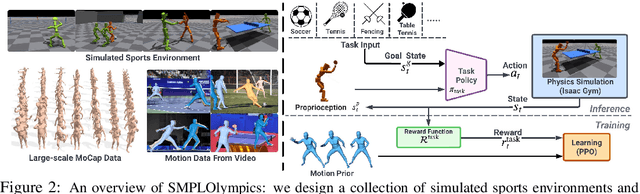

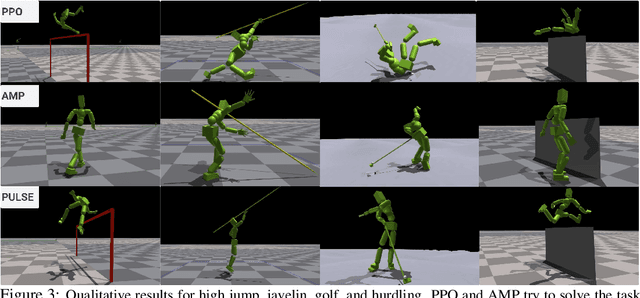
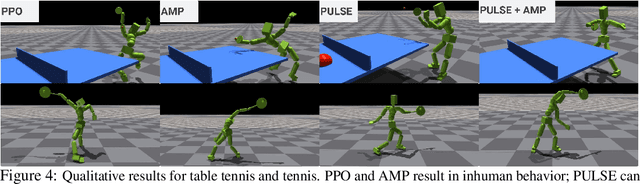
We present SMPLOlympics, a collection of physically simulated environments that allow humanoids to compete in a variety of Olympic sports. Sports simulation offers a rich and standardized testing ground for evaluating and improving the capabilities of learning algorithms due to the diversity and physically demanding nature of athletic activities. As humans have been competing in these sports for many years, there is also a plethora of existing knowledge on the preferred strategy to achieve better performance. To leverage these existing human demonstrations from videos and motion capture, we design our humanoid to be compatible with the widely-used SMPL and SMPL-X human models from the vision and graphics community. We provide a suite of individual sports environments, including golf, javelin throw, high jump, long jump, and hurdling, as well as competitive sports, including both 1v1 and 2v2 games such as table tennis, tennis, fencing, boxing, soccer, and basketball. Our analysis shows that combining strong motion priors with simple rewards can result in human-like behavior in various sports. By providing a unified sports benchmark and baseline implementation of state and reward designs, we hope that SMPLOlympics can help the control and animation communities achieve human-like and performant behaviors.
A Local Appearance Model for Volumetric Capture of Diverse Hairstyle
Dec 14, 2023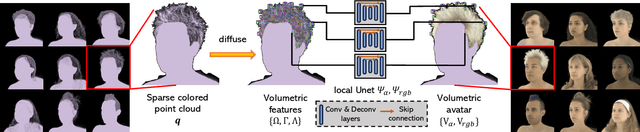
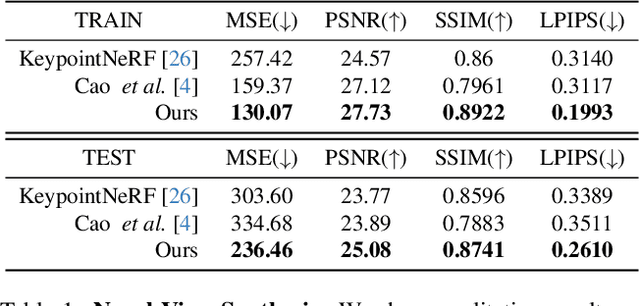
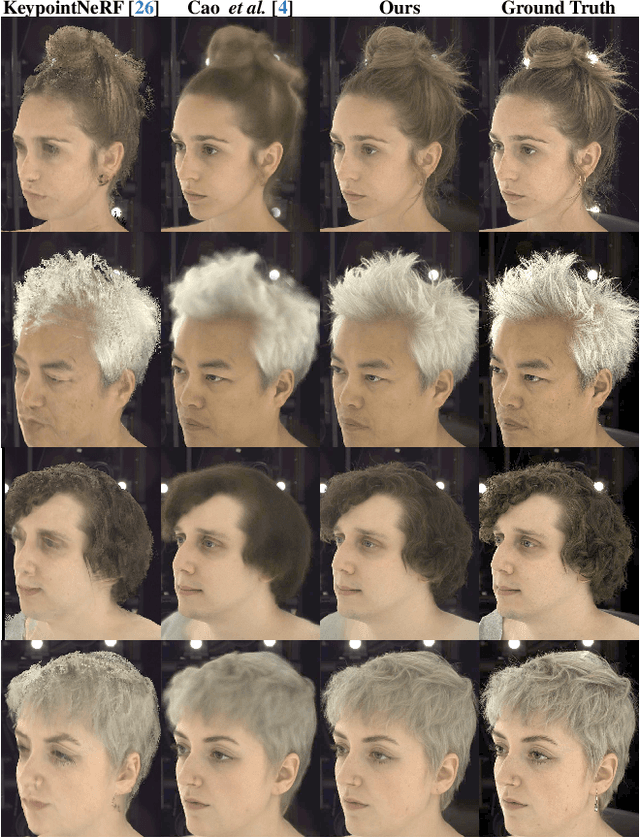
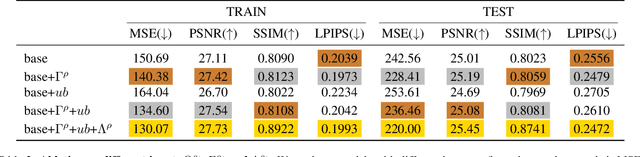
Hair plays a significant role in personal identity and appearance, making it an essential component of high-quality, photorealistic avatars. Existing approaches either focus on modeling the facial region only or rely on personalized models, limiting their generalizability and scalability. In this paper, we present a novel method for creating high-fidelity avatars with diverse hairstyles. Our method leverages the local similarity across different hairstyles and learns a universal hair appearance prior from multi-view captures of hundreds of people. This prior model takes 3D-aligned features as input and generates dense radiance fields conditioned on a sparse point cloud with color. As our model splits different hairstyles into local primitives and builds prior at that level, it is capable of handling various hair topologies. Through experiments, we demonstrate that our model captures a diverse range of hairstyles and generalizes well to challenging new hairstyles. Empirical results show that our method improves the state-of-the-art approaches in capturing and generating photorealistic, personalized avatars with complete hair.
Drivable Avatar Clothing: Faithful Full-Body Telepresence with Dynamic Clothing Driven by Sparse RGB-D Input
Oct 11, 2023


Clothing is an important part of human appearance but challenging to model in photorealistic avatars. In this work we present avatars with dynamically moving loose clothing that can be faithfully driven by sparse RGB-D inputs as well as body and face motion. We propose a Neural Iterative Closest Point (N-ICP) algorithm that can efficiently track the coarse garment shape given sparse depth input. Given the coarse tracking results, the input RGB-D images are then remapped to texel-aligned features, which are fed into the drivable avatar models to faithfully reconstruct appearance details. We evaluate our method against recent image-driven synthesis baselines, and conduct a comprehensive analysis of the N-ICP algorithm. We demonstrate that our method can generalize to a novel testing environment, while preserving the ability to produce high-fidelity and faithful clothing dynamics and appearance.
Simulation and Retargeting of Complex Multi-Character Interactions
May 31, 2023We present a method for reproducing complex multi-character interactions for physically simulated humanoid characters using deep reinforcement learning. Our method learns control policies for characters that imitate not only individual motions, but also the interactions between characters, while maintaining balance and matching the complexity of reference data. Our approach uses a novel reward formulation based on an interaction graph that measures distances between pairs of interaction landmarks. This reward encourages control policies to efficiently imitate the character's motion while preserving the spatial relationships of the interactions in the reference motion. We evaluate our method on a variety of activities, from simple interactions such as a high-five greeting to more complex interactions such as gymnastic exercises, Salsa dancing, and box carrying and throwing. This approach can be used to ``clean-up'' existing motion capture data to produce physically plausible interactions or to retarget motion to new characters with different sizes, kinematics or morphologies while maintaining the interactions in the original data.